
Sustainability
As global warming deepens, we believe that it is part of our social responsibility to leave the beautiful earth to generations to come.
In addition to developing environmentally friendly products and services, we set and promote CO2 reduction targets based on ISO 14001, formulate environmental strategies in line with the TCFD recommendations, and work to improve environmental efficiency through operational streamlining. In the process, we aim to foster a decarbonized society that addresses climate change.
Fujitec is committed to improving the environment by reducing power consumption of our products.
Reduce Scope 1 and 2 greenhouse gas emissions by 46% by 2030 (relative to 2019, sales intensity)
In fiscal year 2024, the amount of CO2 in scope 1 and 2 decreased by 8.5% (compared to the amount in fiscal year 2019, which was set as the base year), resulting in a figure of 21,501 tons. The emissions intensity per net sales decreased by 31.5% from 13.0 tons per 100 million yen in fiscal year 2019, which was set as the base year, resulting in a figure of 8.9 tons per 100 million yen.
We will continue to proactively fulfill our social responsibilities by aiming to solve various social issues such as decarbonization, etc., as an environmentally and socially friendly company, and by deeply considering what contributions we can make as a company responsible for building social infrastructure.
In addition, as our proactive approach to decarbonization, we will promote active information sharing with many suppliers in our supply chain now and in the future.
* CO2 emission figures have been revised retroactively for prior years in accordance with the company’s latest standards, reflecting numerical adjustments necessary due to revisions to the definition of renewable energy usage and changes to the scope of consolidation.
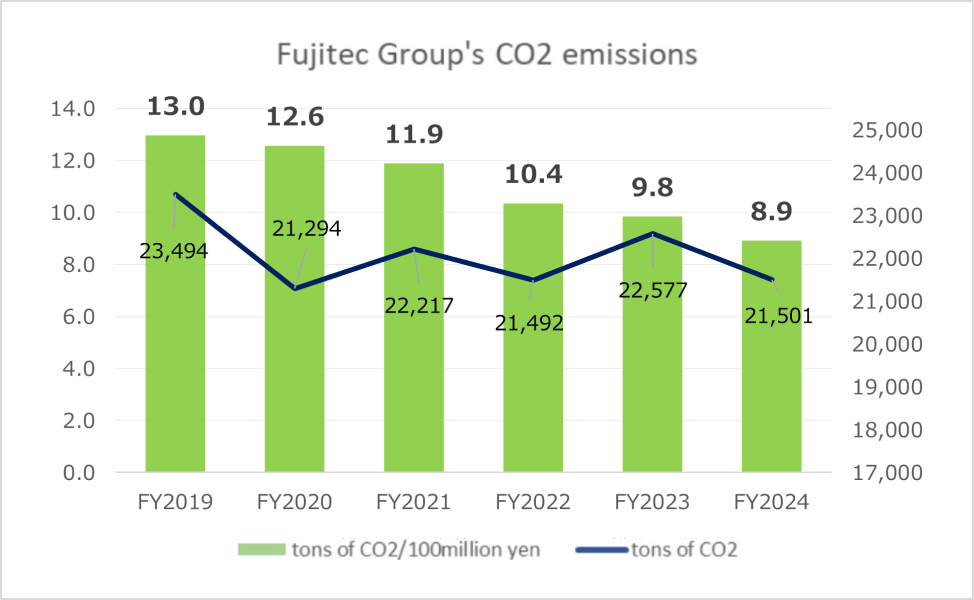
※ Scope for data collection: Head office, factories, branch offices, branch operation bases, sales offices and services centers in Japan

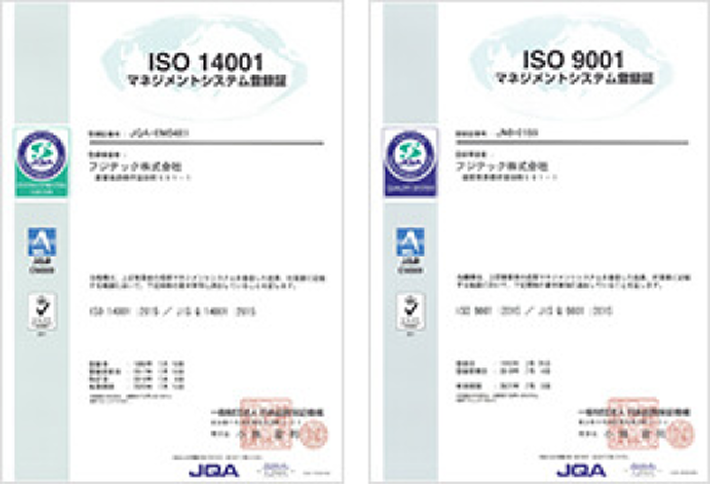
In March, 1993, Fujitec obtained an international standard of ISO9001, which assures the excellent system of quality management as the first ISO-authorized domestic elevator company.
Owing to this, Fujitec's quality assurance system which is very consistent across the whole business operating line of order receipts, designs, productions, product installations, and product maintenance has been proved in the markets.
In addition to the above, an international standard of ISO14001, which ensures the firm establishment of the environmental management system, was awarded to Fujitec in July, 1999.
ISO is the abbreviated word of International Organization for Standardization. This international organization is composed of each country's representative standardization institutes and bears the roles to create various international standards covering the whole industry fields excluding the fields of electricity, communication and electronic technologies.
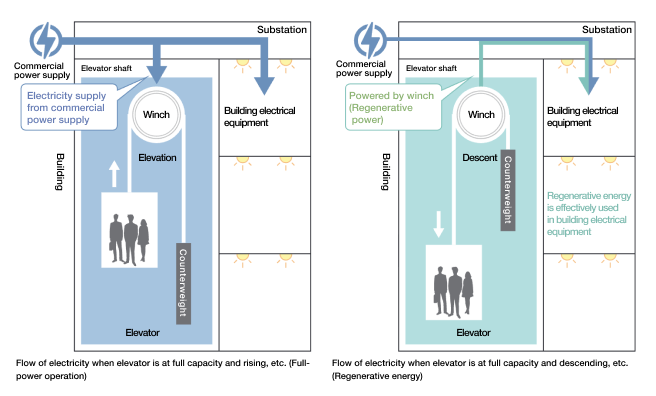
When the elevator descends while at full capacity or under similar conditions, the traction machine functions as a generator producing regenerative power which is then rerouted to the building’s electrical transformer for use within the building.
* May not be available depending on the building’s power supply equipment.
* Installation of this feature may require widening the hoistway.
By switching geared winches with gearless winches, we have improved the mechanical efficiency of our elevators. Furthermore, the use of inverter control has enabled us to make more prease speed adjustments. In these ways, we are contributing to lower CO2, emissions through reduced power.
Environmental Product Declarations (EPDs) for our main product lineups of REXIA / ZEXIA, and ELSIA have been published at the International EPD® System by Environdec.
EPD is a Type III environmental labeling certification program compliant with the ISO 14025 standards. EPDs are founded with the Life Cycle Assessment (LCA), which is based on the cradle-to-grave system boundary and published as final report in leaflet format. By providing information on the environmental impact of a product throughout its life cycle, EPDs enable consumers and users to select and purchase environmentally conscious products.
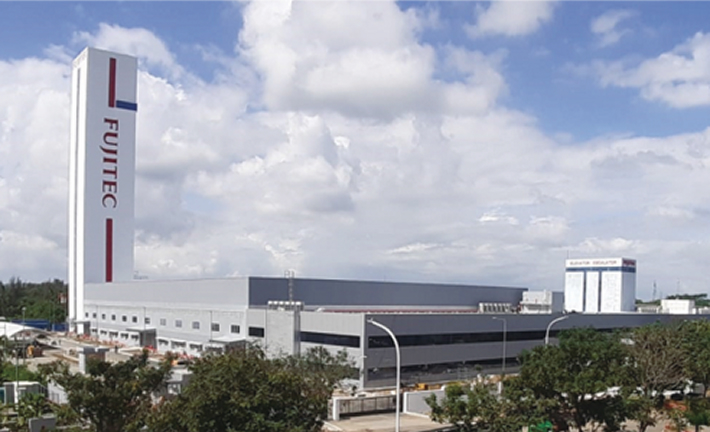
For some time, Fujitec has been installing solar panels at its global sites.In 2025, as part of our environmental impact-reduction measures, we in stalled a solar power generation system on the roof of a warehouse building on the premises of our Big Wing headquarters in ShigaPrefecture.
The generated electricity will be used by our plant on the site, with annual output projected to reach around 700,000kWh. At Fujitec India, we installed solar panels on the plant roof, which helps reduce CO2 emissions while also promoting a shift toward sustainable power sources.
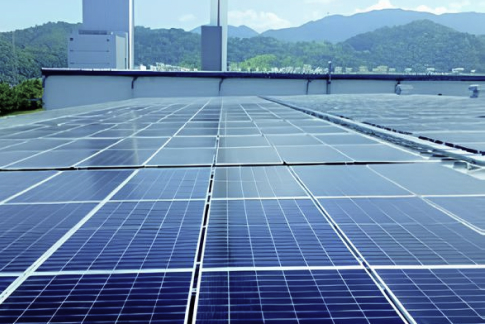
Fujitec India has installed solar panels at its first and second plants and begun generating solar power. Our aim here is to reduce both CO2 emissions and electricity costs.
Solar panels are installed on 75% of the roofs of Fujitec India's first and second plants, with capacity of 383 kW and 315 kW, respectively. By adopting solar power generation, those plants can cover around 35% of their total electricity consumption through renewable energy sources. Fujitec India also installed an online monitoring system to monitor its internal solar power generation and keep track of its electricity generation volume and CO2 emission reductions.
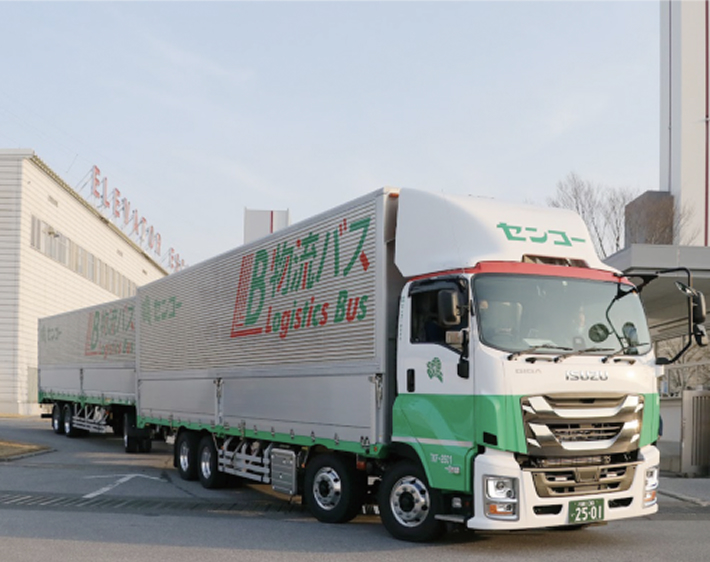
Discussions about CO2 emissions from supply chains call for reductions in such emissions from all kinds of business activities, including those not only in sectors directly involved in manufacturing but also in the transport sector. For part of its logistics, Fujitec uses double-coupled trucks that are operated and managed by Senko Co., Ltd. Each double-coupled truck is 25 meters long and able to transport two 10-ton truckloads with a single driver. Such vehicles can reduce CO2 emissions by about 30% and the driving time by around 40%. We use such vehicles to carry elevator components from Big Wing in Hikone city, Shiga, to two of our logistics hubs: the Tokyo depot in Ota-ku, Tokyo, and the Osaka depot in Amagasaki city, Hyogo.
Now, we use a total of three double-coupled trucks (equivalent to four truckloads): two vehicles that are shared with other companies and one dedicated to us.
Fujitec has been awarded a special prize at the 24th Logistics Environment Award held in June, 2023 by a general incorporated association, Japan Association for Logistics and Transport and also received a categorical prize at the 2022 Logistics Partnership Excellent Business Operator Award hosted by both Ministry of Land, Infrastructure, Transport and Tourism and Ministry of Economy, Trade and Industry.
In addition, in 2024 we received an award in the Category of Resilient and Sustainable Business Operators of the 2024-Year Logistics Partnership Excellent Business Operators, which was hosted by both Ministry of Land, Infrastructure, Transport and Tourism and Ministry of Economy, Trade and Industry. As a major merchant, actively selecting the transportation methods to realizing a Japanese-Unique business way of generating and returning beneficiary to three parties: society, partner companies, and our company, which is called "Sanpo Yoshi (Good for the Parties existing in the Three Directions), we, Fujitec, continues to contribute to the solution of various social issues and the realization of a sustainable society.
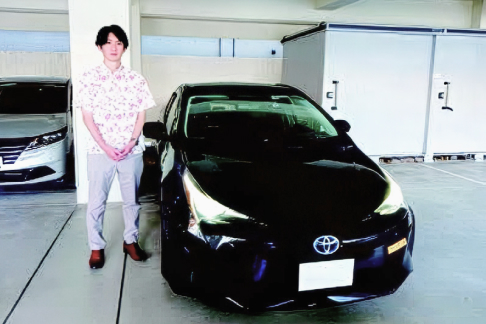
To reduce CO2 emissions from gasoline use, Fujitec is promoting a company-wide shift to more compact vehicles and hybrid cars used in maintenance, inspections, and customer visits.
Our Okinawa branch has transitioned 25% of its company vehicles to hybrid cars.
Our overseas sites are also reducing the number of company vehicles and switching to hybrid models.
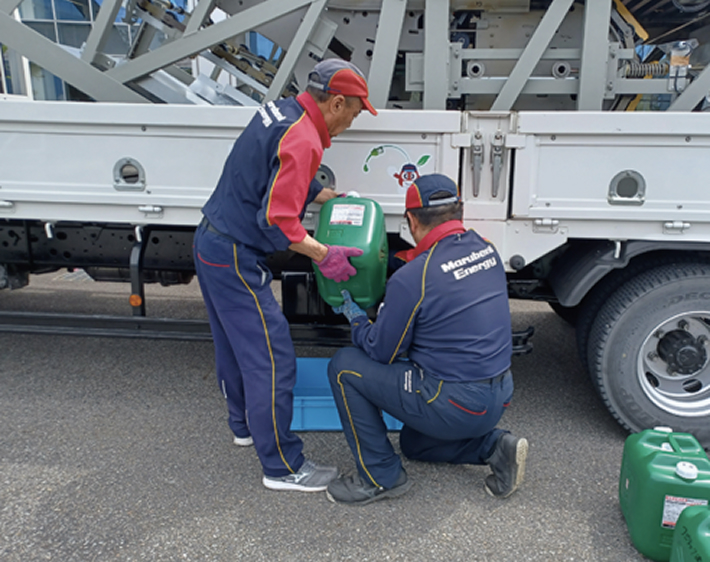
At the Big Step, our research and production hub for escalators, we converted the fuel for our 4-ton trucks from regular diesel to biodiesel in 2024. The biodiesel we use is an environmentally friendly fuel that meets JIS standards and is equivalent in standard to diesel fuel.
It is made from used cooking oil collected from employees' homes and processed by a biodiesel production company using alkaline catalysis and other methods. Recycling used cooking oil that would otherwise be disposed of as waste reduces the amount of garbage incinerated and decreases the use of fossil fuels in our truck operations.
Fujitec is implementing a wide range of initiatives across its domestic and overseas manufacturing sites to reduce environmental impacts and operate eco-friendly plants.
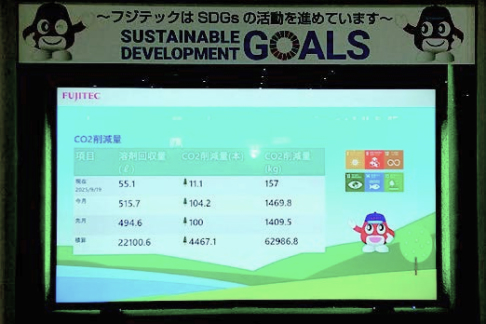
At our Big Wing facility in Japan, we installed a solvent recovery system that allows us to reclaim and reuse about 80% of the solvents we handle.
This has significantly reduced the amount of waste solvent requiring special disposal and lowered CO2 emissions associated with incineration.
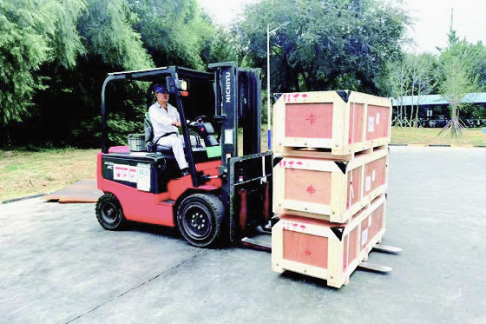
At Huasheng Fujitec (China), we are reducing the number of forklifts and converting them to EV models in an effort to lower CO2 emissions.
We have obtained a score of B in the climate change category from CDP, a UK-based non-profit organization that operates a global environmental information disclosure system. Fujitec has responded to the CDP "Climate Change" questionnaire annually since 2023, and this marks the third time the company has received a "B Score."
CDP gives evaluations using eight levels ranging from D- to A based on the answers the participants provide to an annual questionnaire on the details of their climate change actions.
The B score indicates CDP’s assessment that Fujitec is positioned at the "Management Level," meaning the company is recognized for being aware of and acting on its environmental risks and impacts concerning climate change.
Fujitec identifies “Efforts to reduce environmental impacts” as one of its sustainability materialities (important challenges for organizations/companies). We also disclose in our mid-term business plan, “Move On 5,” that our goal is to achieve a 46% reduction in Scopes 1 and 2 greenhouse gas emissions* by 2030 in comparison with 2019.
To achieve this goal, in fiscal 2024, Fujitec has been promoting activities such as switching to hybrid vehicles for its corporate fleet and introducing solar power generation at its production sites both in Japan and overseas.
We will continue to further promote environmental activities, including the reduction of greenhouse gas emissions, as an entire group.
CDP website: https://www.cdp.net/en
© 2022 FUJITEC CO., LTD.


